
Executive Summary
The software development industry sits at a crossroads. Artificial intelligence has arrived with enormous promise—and with it, a wave of hype, fear, and misapplication that threatens to obscure what AI actually does well. The dominant narrative pits AI against the human workforce, treating automation as a zero-sum game. This paper argues that framing is not only wrong—it is costly.
Drawing on over 250 years of combined leadership experience in software development, quality assurance, and product delivery, the team at AgileAI Labs has built a platform grounded in a different premise: that AI’s highest and best use is not to replace human judgment, but to give that judgment better information, faster, and at every stage of the software lifecycle.
The result is a platform that embeds quality at the requirements phase, carries it all the way through to code generation prompts, and keeps the human in the driver’s seat throughout. This paper explains why that approach matters, what it looks like in practice, and what the industry stands to gain if it gets this right.
The Problem Nobody Wants to Own
Thirty-Five Years of the Same Mistakes
Ask any veteran software professional about the root causes of project failure and you will hear the same answers, over and over: unclear requirements, siloed teams, defects discovered too late, and a culture of accountability that points fingers rather than fixing processes. These are not new problems. They predate AI by decades.
What is new is the volume. As software has become central to every industry, the scale of the dysfunction has grown accordingly. A 2023 study estimated technical debt in the United States alone at $3.4 trillion annually. Globally, the figure stretches into the tens of trillions. That is not an abstraction—that is the accumulated cost of bad requirements, missed defects, reworked code, delayed releases, and systems that never fully delivered on what the business needed.
“Technical debt had reached $3.4 trillion per year in the United States alone by 2023. Globally, the figure is several multiples of that.”
The specific failure mode is well understood: information gets handed off rather than shared. Product owners write requirements in isolation. Those requirements get passed to testing teams who may be in a different country, operating weeks later, with no direct line back to the original intent. Developers receive specifications stripped of context. When something goes wrong—and something always goes wrong—no one can trace back to where the breakdown actually occurred.
This is the silo problem. And it has persisted not because the industry lacks smart people, but because the tooling has never been capable of maintaining a live, shared understanding of a project across all its moving parts. Until now.
What AI Actually Does Well—and What It Doesn’t
The Case for AI as Infrastructure
AI’s genuine strength is informational. It can store, cross-reference, and surface connections across enormous volumes of data in ways that no individual—and no team—can match. In a software development context, that means it can hold the full context of a project: every requirement, every user story, every acceptance criterion, every test case, every piece of security documentation—and make all of it instantly accessible to every stakeholder at every stage.
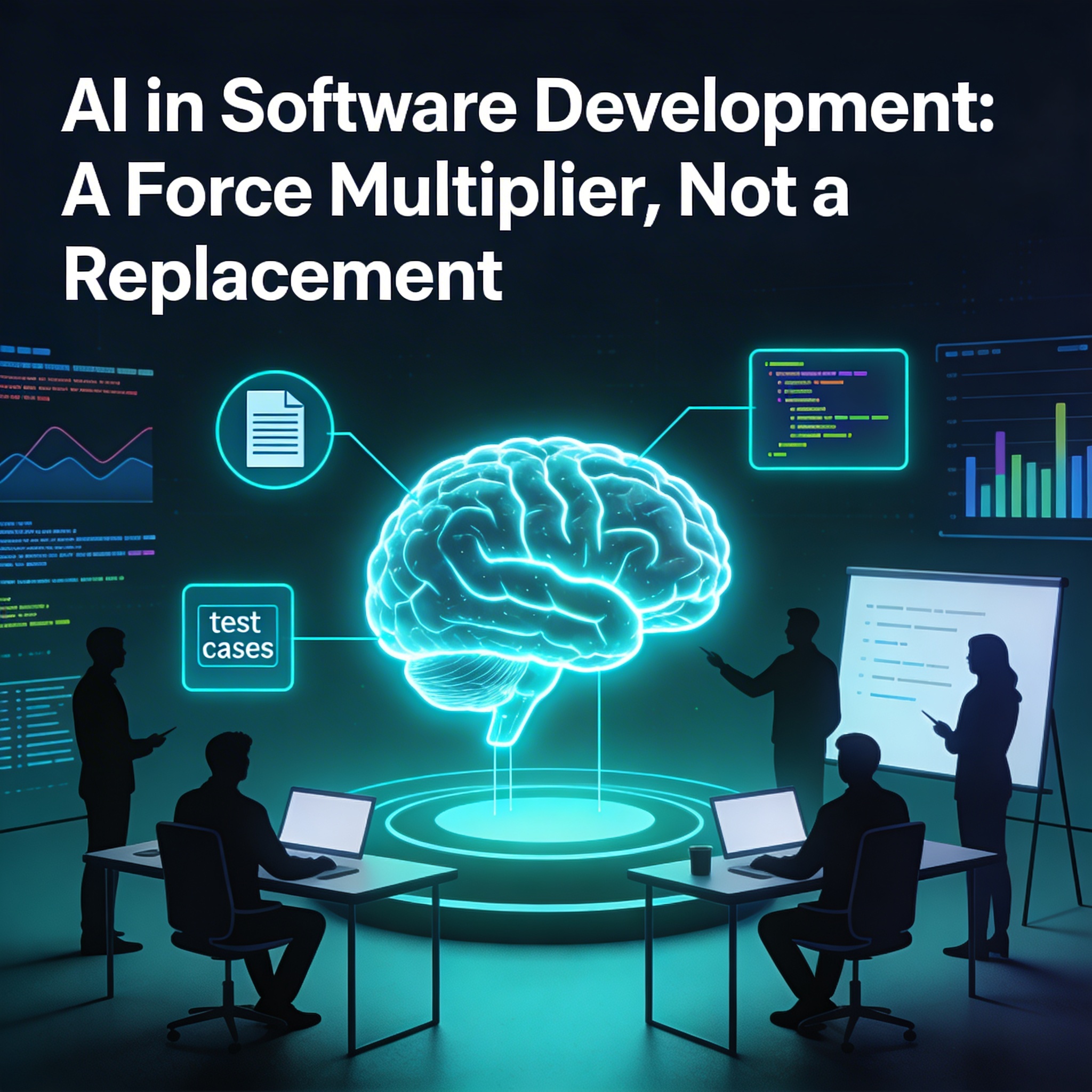
Think of it less as a worker and more as a project brain. Not the decision-maker, but the repository of everything the decision-maker needs to know. When a developer asks what security requirements apply to a specific function, the answer is there. When a tester wants to know which user story a failing test case traces back to, the thread is unbroken. When a business analyst wants to check whether a new requirement conflicts with something already approved, the system can flag it before the meeting ends.
That kind of institutional memory—the kind that traditionally existed only in the heads of long-tenured team members or in sprawling documentation nobody ever read—is what AI can genuinely provide.
Where AI Falls Short
The flip side is equally important. AI hallucinates. It fills gaps with plausible-sounding but incorrect information. And these errors are not always easy to catch—they often look exactly like what you would expect to see, which is precisely what makes them dangerous.
One useful reframe: rather than calling these hallucinations, call them what they functionally are—manipulations. An AI system that fills a knowledge gap with confidently stated misinformation is not malfunctioning in an obvious way. It is performing its core function (generating fluent, coherent responses) in a context where it lacks the knowledge to do so accurately. That distinction matters because it changes how you design around the problem.
“The moment you hand over the keys for AI to do things on its own, you have started down a path that ends badly. AI has the capacity to improve our work. That is very different from replacing the judgment that makes work valuable.”
The answer is not to distrust AI entirely—it is to build systems with explicit guardrails, transparent reasoning, and human review at every decision point. AI without oversight is not a productivity tool. It is a liability.
A Platform Built Around the Root Cause
Requirements: Where Quality Is Won or Lost
The dominant approach to AI in software development has been to apply it downstream—automated test generation, AI-assisted coding, defect detection in production. These are not bad uses. But they address symptoms rather than causes.
If your requirements are vague, contradictory, or incomplete, faster test generation just produces more tests validating the wrong behavior. AI-assisted coding built on bad specifications produces better-written code that does the wrong thing. You cannot hyperaccelerate your way out of a requirements problem. You can only move the reckoning further downstream, where fixing it costs more.
The AgileAI Labs platform was designed to intervene at the source. The requirements phase—where business analysts, product owners, and subject matter experts define what a system should do—is where quality is either embedded or compromised. Everything that follows either builds on that foundation or compensates for its weaknesses.
How AgileAI Labs Works in Practice
The platform takes requirements as input and, rather than simply accepting them, actively works to improve them. It identifies ambiguities, flags missing information, surfaces conflicts between user stories, and asks clarifying questions. After more than 5,000 hours of training and refinement, with guardrails built into every step of the analysis process, the system has become highly capable at catching the kinds of structural problems that typically survive requirements review and cause trouble later.
From enhanced requirements, the platform automatically generates test cases, BDD (Behavior-Driven Development) files, and—most recently—code prompts. These prompts are organized into a color-coded, badged system that allows developers to navigate complex requirements by category: security requirements in one view, functional requirements in another, with the full traceability chain visible throughout.
When code is checked in, the platform analyzes it against the original requirements and test cases in under sixty seconds, flagging failures, explaining why they are failing, and pointing to the specific code that needs to change. Every step is visible, editable, and owned by the human making the decisions.
The Coach Bot: A Different Kind of AI Interaction
Rather than framing AI assistance as a chatbot that answers questions, AgileAI Labs’ conversational interface functions as a project coach. It works with the user throughout the engagement, maintains full context of the project within a dedicated AI engine, and provides information drawn from that project-specific knowledge base rather than from general training data.
At the enterprise level, this means teams can interact with an AI that genuinely knows their project—not a general-purpose model guessing at context. The information stays within the project environment. It does not leave to train other models or become part of a general data pool. Think of it as the institutional memory of a senior engineer who has been present for every decision, available at any moment, without the scheduling constraints of an actual person.
On Layoffs, Efficiency, and the Real Story
The narrative that AI is eliminating technology jobs deserves scrutiny. Some displacement is real and worth acknowledging directly. A testing team of fifteen may, with the right platform in place, be able to accomplish the same work with five people. That is a meaningful change for the individuals involved, and it should not be minimized.
But the current wave of layoffs in the technology sector is not primarily an AI story. It is a business cycle story. Companies that expanded aggressively during a period of low interest rates and high growth expectations are now rationalizing headcount. That would be happening with or without AI. The attribution to AI is, in many cases, a convenient narrative for decisions driven by other factors—and it does a disservice to the people affected, who deserve honest accounting.
The more significant issue is what happens when companies reduce headcount before AI is actually capable of compensating for the loss. The assumption that AI can absorb the responsibilities of eliminated roles is, in most cases, premature. AI needs to be trained to the specific context of a business. Processes need to be redesigned around it. That takes time, expertise, and sustained investment. Companies that skip those steps are not becoming more efficient. They are adding risk.
“If I had a tool like this back in 2008—when I went from one job to four overnight—it would have changed everything. That is what AI should be doing: helping people handle more, not replacing the people who handle things.”
The right sequence is the reverse of what most organizations are doing: bring in AI tools, learn how to use them well, redesign the processes that benefit from AI augmentation, and let headcount naturally rationalize over time. Done in that order, AI genuinely does make people more productive. Done in reverse, it creates chaos and leaves organizations exposed.
The Governance Problem Nobody Is Solving
Unguardrailed AI Is Not a Product
The barrier to entry for building an AI-powered tool has never been lower. A large language model, an interface, a business registration, and you have a product—at least on paper. The market has been flooded with tools that are essentially wrappers around general-purpose models, with minimal training, no domain-specific guardrails, and no accountability framework for the outputs they generate.
This is not a minor concern. An unguardrailed AI system in a professional context—software development, legal, medical, financial—is not neutral. It produces confident-sounding outputs that users may act on without understanding their limitations. When those outputs are wrong, the consequences range from wasted effort to serious harm. And the user, not the vendor, typically bears that cost.
Evaluating an AI tool for professional use requires asking hard questions: How was it trained? On what data? By whom? What guardrails exist at each step? How does the system handle situations where it does not have sufficient information? How transparent is it about its reasoning? Tools that cannot answer these questions should not be trusted with consequential work.
The Regulatory Landscape
The European Union and the United Kingdom have moved seriously on AI governance, establishing frameworks that impose real obligations on AI developers and deployers. The United States, by contrast, has largely left the field to voluntary standards and market forces. That gap creates risk.
Regulation done well does not slow innovation—it channels it. When companies know they will be held accountable for the quality and safety of their AI systems, they invest more seriously in training, testing, and transparency. When accountability is absent, the incentive to cut corners wins. The current environment in the US is, frankly, the Wild West. That will eventually change, and the companies that have already built responsible practices will be better positioned when it does.
Data, Privacy, and the Informed User
Every query entered into a publicly accessible AI system contributes to a data pool. Most users understand this in the abstract; far fewer think carefully about what it means in practice. Business strategies, financial projections, client information, proprietary processes—all of this, entered into an unguardrailed AI tool, leaves your environment. Where it goes, how it is used, who has access to it, and whether it influences outputs seen by competitors are questions that should concern every professional.
This is not speculation. There have been documented cases of proprietary information entered into AI tools appearing in outputs served to others. There have been legal cases involving model behavior that suggested training data was being used in ways users did not consent to. The risks are real, documented, and growing.
The responsible approach—for individuals, teams, and organizations—is to treat AI tools with the same data hygiene standards applied to any third-party system. Enterprise-grade platforms with dedicated data environments, clear contractual data protections, and transparent model governance are a different category of tool than publicly available general-purpose models. That distinction matters enormously, and it should be part of any serious AI procurement discussion.
What Good Looks Like Going Forward
The Contiguous Process
The most compelling opportunity AI presents in software development is not speed. It is coherence. For the first time, it is possible to maintain an unbroken thread of context from the original business requirement all the way through to production release—with every decision, every trade-off, every test case, and every piece of code traceable back to the need it was built to serve.
That thread has been broken at almost every handoff in traditional software development. Requirements teams hand off to testers who hand off to developers who hand off to QA who hand off to operations. At each transition, context is lost, assumptions are made, and accountability diffuses. When something fails in production, reconstructing the chain of decisions that led there is often impossible.
A platform that maintains that context—that functions as the connective tissue between every stage of the process—changes the accountability dynamic entirely. Defects can be traced to their source. Decisions can be reviewed. Patterns of failure can be identified and addressed at the level where they originate rather than where they surface.
Human Leadership in an AI-Augmented Environment
None of this changes the fundamental requirement for human judgment at every meaningful decision point. It changes the quality of information available to that judgment, the speed with which it can be applied, and the traceability of its consequences.
The professionals who will thrive in this environment are those who treat AI as a capable but unreliable junior colleague: useful for drafting, research, and synthesis; requiring review, correction, and direction; never trusted to operate unsupervised on consequential work. That is not a limitation to be apologized for. It is the appropriate relationship between human expertise and a tool that augments it.
The organizations that will thrive are those that redesign their processes to take full advantage of what AI can do—maintaining institutional knowledge, surfacing conflicts, accelerating repetitive tasks—while preserving the human oversight that makes those processes trustworthy.
Conclusion
The fear that AI will replace human professionals is understandable but, in the context of thoughtfully designed systems, largely misplaced. The real risk is the opposite: that organizations will deploy AI carelessly, without guardrails, without training, without redesigning the processes around it, and then wonder why the results are disappointing—or dangerous.
The software industry has struggled with the same quality and accountability problems for decades. Requirements-to-defect cycles, siloed teams, technical debt measured in trillions of dollars—these are structural failures that no amount of headcount can fix on its own. AI, applied at the right point in the process and with the right architecture, offers a genuine path to fixing them.
But that path requires discipline: choosing tools that have been seriously trained, that are transparent about their reasoning, that keep humans in control, and that are designed to maintain quality across the full lifecycle rather than accelerating defects through it faster. The difference between AI as a force multiplier and AI as an expensive mistake comes down to how seriously those requirements are taken.
Software is everyone’s business now. Getting this right matters beyond the industry.
About Agile AI Labs
AgileAI Labs, Inc. mitigates risk, reduces cost, and eliminates rework by proactively addressing preventable software defects before coding begins. The company offers a no-code, natural language, generative AI (GenAI) platform purpose-built for SDLC defect prevention. The insight driving its creation was straightforward: the highest-leverage point to improve software quality is not downstream testing or post-release patching—it is the requirements phase, where ambiguity, conflict, and incompleteness are introduced before a single line of code is written.
Good leaders know the key to project success is getting the entire team aligned around context-rich requirements with a clearly defined end goal. AgileAI Labs guides project setup from day one, analyzing and rating incoming requirements—user stories and acceptance criteria—against 32 best-practice business measures and cross-story analysis. The platform then generates enhanced requirements recommendations with full transparency, improving clarity, testability, and stakeholder alignment before work begins. Security requirements are automatically recommended and aligned to functional context, eliminating confusion about security expectations across the team.
From enhanced requirements, AgileAI Labs automatically generates test cases and full traceability, BDD feature (Cucumber) and step files, and Selenium and Robot Framework scripts—saving teams hours of automation prep. Unit tests can be generated into a Swagger file and imported directly into tools like Postman for immediate automation. In January 2026, AgileAI Labs extended its human-in-the-loop vision with the launch of a quality prompt generation module that bridges the gap between validated requirements and AI-assisted development.
The platform’s patent-pending predictive testing and code analysis feature identifies code fail points instantly—giving development teams the information they need to fix problems before they reach production. The result is measurable improvement in quality, security, and productivity across every build. Mitigate risk. Reduce cost. Ship with confidence.