
May 2026
About the Interviewee
Mario Damesco is building MainSquare around a persistent problem in the lower middle market: the gap between a strong strategy and the operational discipline required to execute it. With more than seven years advising private equity firms, family offices, and investment banks on value creation and business transitions, his work has spanned manufacturing, food production, energy, freight, and facilities management.
Across those industries, one pattern kept appearing — the companies that create durable value are the ones that prepare early, clean up their workflows, strengthen their financial foundation, and build transferable value before a transaction ever begins.
Executive Summary
In the middle market, value creation is rarely blocked by a lack of ambition. The real issue is execution. Founders, sponsors, and operators often know where the business should go, but they do not have the operating system to get there consistently. MainSquare exists to close that gap by acting as a post-acquisition operating partner for owner-operators, CEOs, search fund investors, private equity firms, and portfolio company leaders who need more than a recommendation. They need a structure that turns strategy into repeated execution.
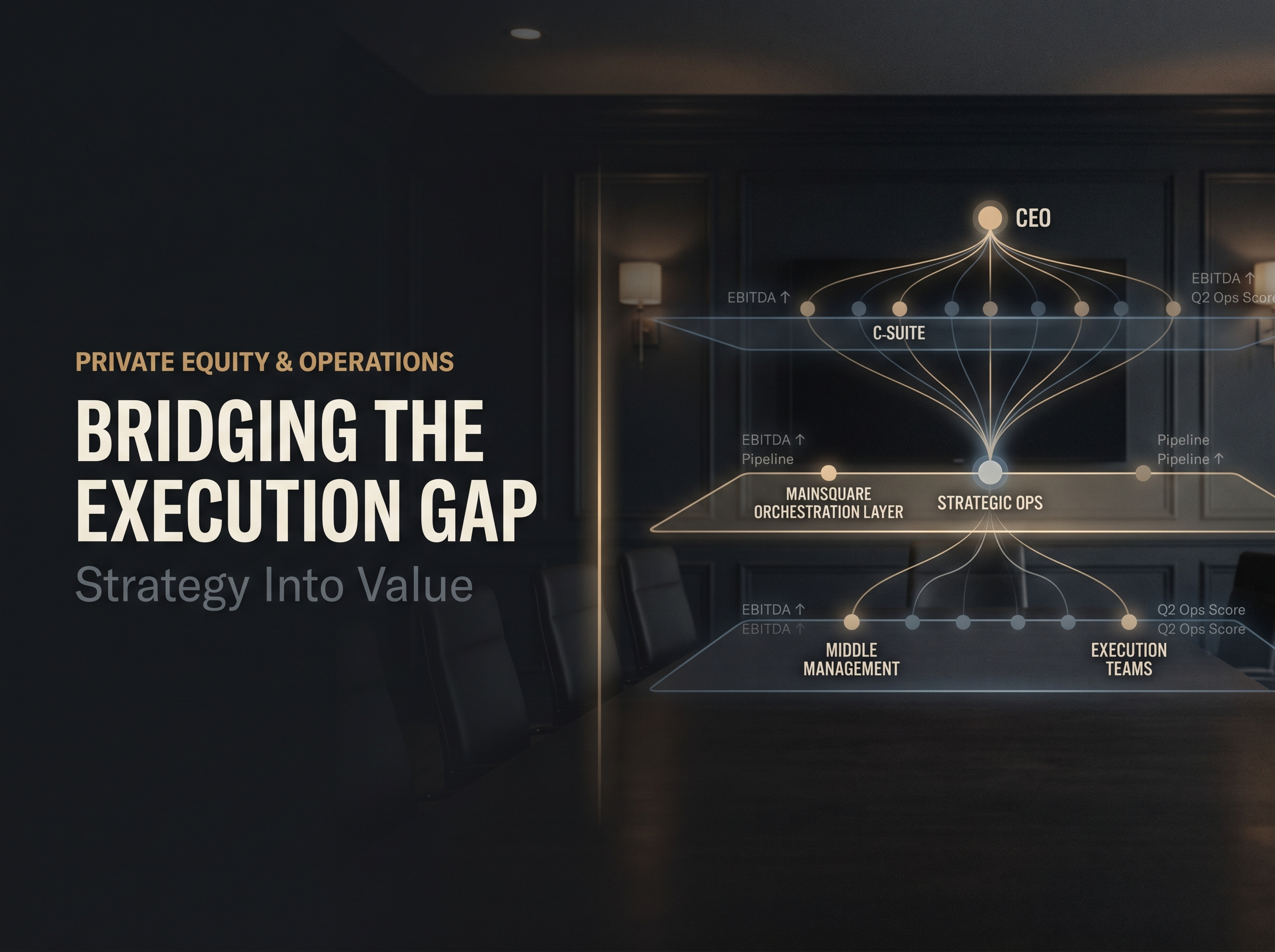
The company sits in what Mario describes as the “layer two” of the organization: the orchestration layer between the CEO and middle management. That is where value creation plans are built, KPIs are defined, dashboards are installed, accountability is distributed, and day-to-day movement is tracked against the strategy. The thesis is simple but demanding: sustainable value creation requires both strategic vision and tactical execution, and those two things only work when the organization is aligned around the same scoreboard.
The Core Problem: Strategy Fails in the Middle
Most companies do not fail because they lack a plan. They fail because the plan does not survive contact with the organization. The CEO may define a transformation agenda, but without a strong operating layer to translate that agenda into workflows, metrics, and accountability, the strategy loses momentum quickly.
That is especially true in the lower middle market, where many businesses have grown through experience rather than through formal operating systems. Their workflows may be fragmented, their reporting may be inconsistent, and their organizational structure may be difficult even for insiders to describe clearly. In that environment, strategy often exists as intent rather than as execution.
The Hidden Cost of Complexity
One of the most important observations from Mario’s perspective is that companies frequently do not understand the central workflow of information inside their own business. Some are organized around product lines, others around customers, suppliers, or end products, but many have layers of complexity that obscure how work actually gets done.
That complexity creates a real cost. If leadership cannot map how information moves through the business, it becomes difficult to identify bottlenecks, standardize decisions, or prepare the company for transformation. MainSquare’s role is to make that workflow visible and usable so that improvement can become systematic rather than improvised.
MainSquare’s Model
The Layer Two Operating Partner
MainSquare positions itself as a post-acquisition operating partner for middle-market businesses, especially those in industrial, manufacturing, services, and logistics-heavy sectors with roughly ten to one hundred million dollars in revenue. The company supports owner-operators, search fund investors, private equity firms, and CEOs who need help translating investment theses into measurable operating progress.
The key idea is that the CEO should not have to carry the entire transformation alone. MainSquare extends the reach of the top team by standing up the value creation plan, building the KPI and BI scoreboard, and helping create the accountability structure that keeps the organization moving. In practice, that means helping leadership see good days from bad days, understand whether the business is tracking toward its strategy, and ensure that the second and third layers of management are aligned around execution.
Why Accountability Matters
Value creation plans often die in middle management, not because the plan is wrong, but because there is no repeatable mechanism to carry it forward. MainSquare steps into that gap by helping build the system around the plan, not just the plan itself.
That distinction matters. A recommendation can be useful, but it does not change behavior on its own. Execution requires visibility, ownership, and operational rhythm. By focusing on those elements, MainSquare turns transformation from a one-time project into an operating discipline.
AI in the Middle Market
Not Ready for Automation Everywhere
Mario is clear that most lower middle-market businesses are not ready to adopt AI across financial or operational execution in a broad way. The main barrier is not access to technology. It is the state of the business itself.
The first issue is workflow clarity. If the organization does not understand how information is structured or how decisions move through the business, AI only amplifies confusion. The second issue is data quality and data integrity. AI systems can only be as good as the data they receive, and poor data produces poor outputs.
Low-Hanging Fruit Exists
That does not mean AI has no role. In fact, Mario points to highly practical use cases where the workflows are standardized enough for automation to make sense. Invoicing is one example, especially when pricing lists, customer databases, and email structures are already in place. Purchase orders are another, particularly when the relevant pricing sheets or inventory data are consistent.
These use cases matter because they show how AI can be deployed incrementally. Rather than trying to automate the entire business at once, companies can begin with repeatable back-office workflows that are already structured enough to support automation. That approach reduces risk and creates early wins.
Where AI Breaks
Exceptions Are the Problem
Mario also highlights a common failure mode: companies try to deploy AI into environments full of exceptions. Scheduling optimization is a good example. In one case, a plastics manufacturer had schedules changing within twelve hours, when ideally they should have been locked at least forty-eight hours or even a week in advance. The problem was not the AI tool itself. The problem was the volatility of the process.
When exceptions pile up, AI systems struggle because they are not good at improvising around unstable inputs. Human operators can absorb variability in ways software cannot. If the underlying process is too chaotic, the tool will fail or produce inaccurate outputs.
AI Is Phase Three
One of the strongest ideas in the conversation is that AI should not be treated as phase one. It is not the starting point of operational maturity. It is phase three, after the company has cleaned up workflows, standardized data, and reduced human dependency where possible.
That framing is especially useful for sponsors and search fund operators. It suggests that the right sequence is not “buy AI, then figure out the business.” It is “understand the business, align the systems, and then apply AI where it can actually work.” That order is what separates useful automation from expensive experimentation.
Advice for Sponsors
Start With Visibility
For sponsors, search funds, and operators, the first priority is visibility. A business must know where money comes from, where it goes, and how information moves through the organization. Without that map, automation is guessing.
MainSquare’s perspective is that a business is essentially inputs and outputs, and the quality of the logic path between those two points determines whether AI can be useful. If the company does not understand its own operating logic, it cannot meaningfully map AI to it.
Align Systems Before Scaling
The second priority is system alignment. Data outputs need to match the workflow structure, or automation will not reflect reality. Once the company has cleaned up the process layer and the data layer, AI can be introduced more confidently and with better results.
That is where MainSquare’s model becomes especially relevant. It is not simply about installing dashboards or recommending new tools. It is about building the conditions under which transformation can actually hold.
Why This Work Matters: Sustainable Value Needs Both Sides
The most important thread running through the conversation is that sustainable value creation requires both strategic vision and tactical execution. Strategy defines direction. Execution determines whether the direction becomes reality.
MainSquare is built to operate in that tension. By serving as the orchestration layer between leadership and middle management, the company helps businesses turn aspiration into structure, structure into accountability, and accountability into measurable value. In the middle market, that may be the difference between a company that simply announces transformation and one that actually completes it.
About MainSquare
MainSquare governs the execution gap between strategy and transformation for founders, search funds, and private equity sponsors who need more than a recommendation. The firm supports middle-market businesses by building the operating systems, KPIs, accountability structures, and workflow clarity needed to translate strategy into durable value creation.
About StartupSword.com
StartupSword.com is an editorial platform publishing candid, experience-first conversations with the founders, operators, and builders shaping the next generation of business and culture. This white paper is part of the Entrepreneurship & Innovation Series, which profiles practitioners with a track record of doing the work — not just talking about it.