
About the Interviewee
TreeTrack is an AgTech reforestation company focused on helping restore forests at the scale climate goals now require. By combining customized drones and UAV technology with operational expertise in land restoration, the company is building a faster, more flexible model for planting trees across North America and beyond. Its broader mission is to reduce carbon emissions while supporting Canada’s goal of planting 2 billion trees by 2030.
Executive Summary
Reforestation is one of the clearest climate actions available, but the scale of the challenge has outgrown traditional methods. Planting trees manually is slow, labor-intensive, and difficult to apply consistently across remote, rugged, or degraded landscapes. That gap has created an urgent need for new infrastructure that can move restoration from a local effort into a scalable system.
TreeTrack is responding to that need with a technology-driven model. Using customized drones and UAVs, the company aims to accelerate tree planting, expand access to hard-to-reach terrain, and help land restoration operate with the kind of speed and consistency climate targets demand. In a world where environmental outcomes areincreasingly measured by scale and speed, TreeTrack is positioning aerial planting as a practical pathway to greater impact.
Why Reforestation Needs Reinvention
The Scale Problem
The climate challenge is not only about reducing emissions; it is also about restoring ecosystems that can absorb carbon and support long-term resilience. Reforestation sits at the center of that work. Yet the traditional model of planting trees by hand has major limitations when the goal is national or continental scale. Labor availability, terrain difficulty, weather windows, and access constraints all reduce how much can be planted in a given season. In many cases, the places that most need restoration are the same places that are hardest to reach. That makes the economics of large-scale reforestation difficult, especially when the timeline for action is measured in years rather than decades.
Climate Goals Require Better Infrastructure
Policy goals such as Canada’s target of planting 2 billion trees by 2030 are important because they create a measurable benchmark. But setting a target is not the same as building the capacity to achieve it. Meeting that kind of ambition requires better logistics, better deployment methods, and better coordination between planning and execution.
That is where TreeTrack’s model becomes relevant. The company is not treating reforestation as a purely manual task. It is approaching it as an operational system that can benefit from aerial technology, precision delivery, and a more scalable planting process.
How TreeTrack Works
Customized Drones and UAVs
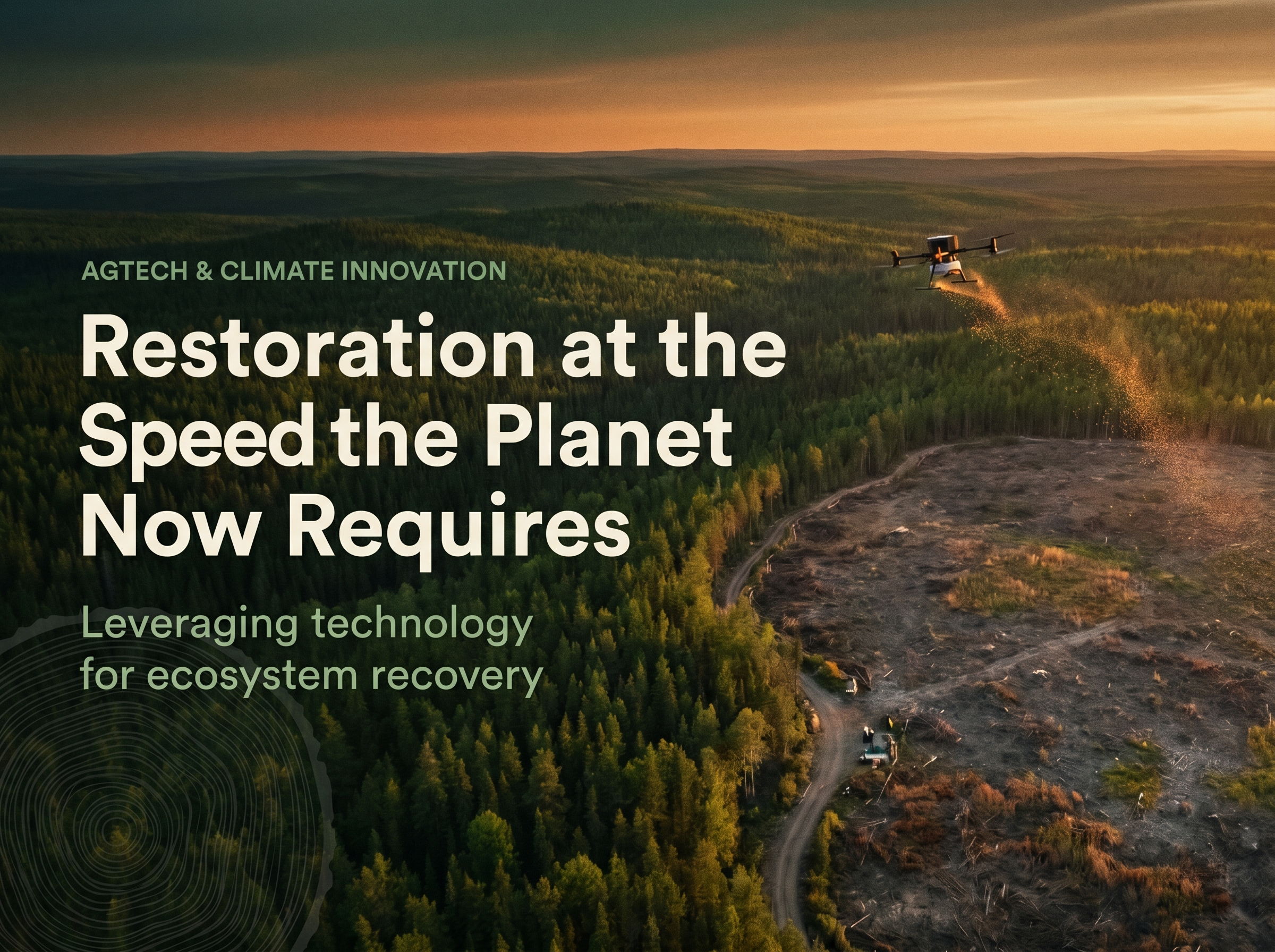
TreeTrack uses customized drones and UAV platforms to help plant trees more efficiently than conventional ground-based methods. This matters because aerial systems can cover terrain that would be slow, expensive, or impractical to reach on foot. They also create a more adaptable deployment model, particularly in areas where environmental conditions or geography make manual planting inefficient.The customization aspect is important. Reforestation is not a one-size-fits-all problem. Different landscapes require different deployment strategies, and the ability to tailor drone systems to specific project conditions makes the technology more useful in practice. Rather than forcing restoration to fit a generic tool, TreeTrack is shaping the tool to fit the restoration problem.
Faster Deployment, Broader Reach
At a basic level, drones improve speed. They can help move planting operations across larger areas in less time, which expands the total amount of land that can be addressed during a planting season. But speed alone is not the full story. The deeper advantage is reach. When reforestation teams can access difficult terrain more effectively, they can expand restoration beyond the easiest sites and into the landscapes where intervention may be most needed. That gives TreeTrack a role not just in accelerating planting, but in widening the set of places where restoration can realistically happen.
The AgTech Opportunity
Agriculture Meets Climate Infrastructure
TreeTrack sits within a broader shift in how climate solutions are being built. AgTech is no longer limited to food production or precision farming. It is increasingly becoming a category for environmental infrastructure: tools, systems, and workflows that help land-based industries operate more intelligently and sustainably.
Reforestation fits naturally into that expansion. It requires field operations, environmental knowledge, logistics, and measurable outcomes. These are all characteristics that modern AgTech can support. TreeTrack’s model shows how climate restoration can be treated not as a purely ecological effort, but as a technology-enabled system with real operational design.
Carbon Reduction as an Operational Outcome
The company’s mission to reduce carbon emissions gives the work a broader climate frame. Trees are valuable not only because they restore landscapes, but because they contribute to carbon sequestration over time. In that sense, reforestation becomes both an environmental and an operational objective.What matters most is that the climate benefit is linked to execution quality. Trees only contribute to long-term impact if planting is done effectively and at sufficient scale. By helping make restoration more practical, TreeTrack is working on the infrastructure that makes carbon outcomes possible in the first place.
Why Canada Matters
A National Target With Global Relevance
Canada’s 2 billion tree goal by 2030 is a useful marker because it turns reforestation into a public commitment rather than a vague aspiration. It creates urgency, accountability, and a benchmark for evaluating whether restoration efforts are actually scaling. For companies like TreeTrack, that goal represents both a challenge and an opportunity.
The challenge is obvious: planting at that level requires systems that can move beyond pilot projects and into repeatable deployment. The opportunity is equally clear: if a company can help solve that problem in Canada, the same model can potentially be adapted to other regions facing similar restoration needs. In that way, TreeTrack’s work is relevant not only domestically but globally.
From Local Projects to Repeatable Systems
One of the most important shifts in climate technology is the move from isolated initiatives to reusable infrastructure. A successful reforestation project is valuable. A repeatable framework for many projects is transformational.
TreeTrack’s drone-enabled approach points in that direction. Rather than treating each project as a one-off effort, the company is building a platform for consistent deployment across multiple geographies. That is what turns reforestation from an environmental activity into a scalable climate system.
The Bigger Vision
Restoration as a Modern Industry
TreeTrack represents a broader idea: restoration should be treated like modern infrastructure. That means designing for speed, consistency, adaptability, and measurable impact. It also means using technology not as a novelty, but as a practical tool for making environmental work more efficient and more accessible.If the next decade of climate action is going to be judged by execution, then the companies that matter most will be the ones that can turn ambition into operational reality. TreeTrack’s vision sits squarely in that category. It is building not just a way to plant trees, but a way to make large-scale reforestation feasible at the pace the planet now requires.
About TreeTrack
TreeTrack is an AgTech reforestation company using customized drones and UAV technology to accelerate tree planting and support carbon reduction efforts across North America and beyond. The company is helping create a more scalable path toward reforestation, with a particular focus on supporting Canada’s goal of planting 2 billion trees by 2030