
About the Interviewee
Maceo is building Datost around a sharp observation about modern work: most business teams do not suffer from a lack of data, but from a lack of access to decisions at the moment they need to make them. Datost addresses that gap by acting as a Slack-native AI data analyst for teams across marketing, product, sales, and operations, allowing shared metrics and business questions to live in the same thread where action is already being discussed.
Executive Summary
The last decade of business intelligence produced a paradox. Companies invested heavily in dashboards, reporting layers, reverse ETL pipelines, and modern analytics tooling, yet many frontline business teams still struggle to get timely answers to simple operational questions. A marketer wants to know why conversion dipped. A sales manager needs pipeline movement by segment. A product lead wants to compare retention before and after a release. In theory, modern data stacks should make these questions easy. In practice, they often trigger a slow chain of queries, dashboard checks, analyst requests, and fragmented interpretations.
Datost enters this environment with a different premise: business intelligence should not be a destination, and analytics should not be trapped inside specialist workflows. Instead of sending teams to a separate BI environment, Datost brings the analysis layer into Slack itself. The result is a model where the question, the answer, the context, and the decision all sit in one place. This paper explores why that shift matters, how “dashboard debt” became a hidden tax on execution, and why conversational analytics may become one of the defining interfaces of the next era of software.
The Problem Behind Modern Analytics
Data Infrastructure Improved, Decision Velocity Did Not
The modern data stack solved many technical problems. Warehouses became cheaper, transformation became more reliable, and dashboards became more flexible. But for business users, one core issue remained unresolved: the path from question to answer is still too long.
This gap matters because most business decisions are time-sensitive. A useful metric is not simply one that exists; it is one that can be surfaced at the right moment, interpreted in context, and acted on without delay. The friction is rarely about raw storage or compute. It is about workflow. When teams have to leave their operating environment, search for the right chart, verify definitions, and then relay the result back into a conversation, analysis becomes slower than the pace of the business itself.
The Rise of Dashboard Debt
Dashboard debt is one of the least discussed consequences of the analytics boom. Every request for visibility often produces another dashboard, another chart, another saved view, or another one-off query. Over time, companies accumulate a large reporting surface area that is expensive to maintain and difficult to trust. The challenge is not only clutter. It is misalignment. Different teams may look at different dashboards, use slightly different definitions, or interpret the same number in different contexts. In that environment, dashboards stop acting as a shared source of Truth and start becoming isolated snapshots. The cost is not only technical overhead, but organizational drag.
Datost’s Thesis
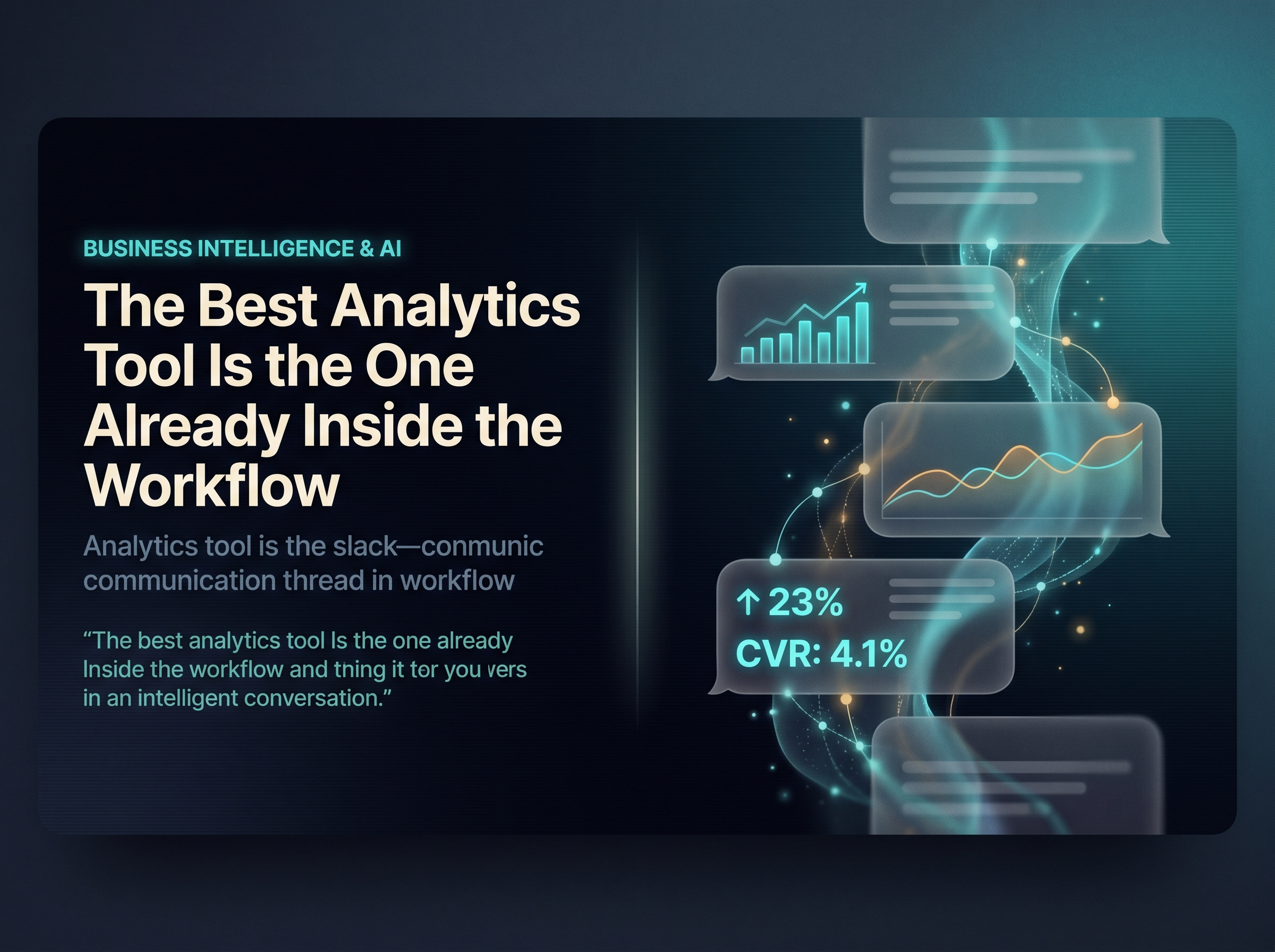
The Best Analytics Tool Is the One Already Inside the Workflow
Datost is built on a simple but powerful product thesis: if teams already coordinate, debate, and decide in Slack, then data analysis should happen there too. Rather than asking users to open a separate BI platform and translate insights back into a team thread, Datost places the analytical interface directly inside the conversation.
This changes the role of analytics from a periodic reporting function into a live operational capability. A team does not need to prepare for a dashboard review to ask a question. It can ask in the moment, in the same thread, with the same stakeholders present. That seemingly small shift alters the speed and shape of execution. It shortensfeedback loops, reduces context switching, and creates a tighter connection between data and action.
Shared Metrics in a Shared Thread
One of Datost’s most important ideas is that alignment should be social as well as technical. It is not enough for a company to define metrics centrally if each team accesses them in different places and at different times. Datost’s Slack-native model means product, sales, marketing, and operations can engage with the same question in one shared space. That matters because cross-functional work often breaks down not from disagreement about goals, but from inconsistency in interpretation. When the answer to a business question appears in the same thread where the decision is being made, ambiguity shrinks. The metric is no longer abstracted away in a distant dashboard. It becomes part of the conversation itself.
Why This Matters Now
Business Teams Cannot Afford Analytics Delays
The pace of decision-making has accelerated across nearly every function. Marketing teams adjust campaigns daily. Product teams monitor launch effects in real time. Sales leaders respond quickly to pipeline changes. Operations teams need immediate visibility into performance anomalies. In each case, lagging access to data creates real costs. What once felt acceptable in monthly reporting cycles now feels outdated. The core tension is clear: businesses increasingly operate in real time, but many analytics systems still behave like retrospective reporting tools. Datost’s positioning responds directly to that mismatch by treating analytics as an active layer of work rather than a passive record of it.
AI Makes Conversational Analytics Viable
For years, the idea of asking business questions in natural language existed mostly as a product promise. The challenge was not the interface itself, but whether the answers would be reliable, contextual, and usable. The growing maturity of AI systems has reopened that category with much stronger product potential.
Datost fits into that shift by framing AI not as a standalone novelty, but as infrastructure for decision support. The goal is not to impress users with a chatbot. The goal is tocompress the time between question and answer, while preserving shared context and reducing operational friction. In that sense, the company is less about chat and more about execution velocity.
A New Model for BI
From Reporting Layer to Operating Layer
Traditional BI tools function as reporting environments. Datost points toward a different model: analytics as an operating layer woven into day-to-day teamwork. This is a deeper change than interface design. It suggests that the future of analytics may not be defined by better dashboards, but by better integration into the places where work actually happens.
When analytics becomes an operating layer, the value of the system changes. Instead of measuring success by dashboard adoption or report volume, the relevant question becomes whether teams can resolve uncertainty faster. Can they identify a change, understand the cause, and align on next steps without leaving their workflow? Datost is built around the belief that this is the metric that matters most.
The Analyst Role Evolves, Not Disappears
A common misunderstanding about AI analytics tools is that they eliminate the need for analysts. In practice, the more realistic outcome is role evolution. Routine business questions can be answered more quickly inside the team workflow, while analysts focus on governance, metric design, data quality, and deeper strategic investigations.
This distinction is important. Datost does not make expertise irrelevant. It makes expertise more leverageable. Instead of spending time responding to repetitive ad hoc requests, data teams can spend more energy building stable systems and improving how the organization defines and interprets its core metrics.
The Strategic Opportunity
Speed Becomes a Form of Intelligence
In many organizations, intelligence is still treated as something static — a report, a dashboard, a weekly summary. But operationally, intelligence is often better understood as speed with context. The company that can ask the right question and get the right answer quickly gains an advantage that is both tactical and structural.Datost’s promise is rooted in that idea. It is not only about making analytics easier to access. It is about making companies more responsive. A faster route to clarity enables faster iteration, faster alignment, and faster execution. Over time, those gains compound.
The Interface Shift Ahead
Every software category eventually gets reshaped by interface change. Spreadsheets changed finance. CRMs changed sales operations. Team messaging changed coordination. Datost suggests that business intelligence may now be entering its own interface transition — away from standalone dashboards and toward conversational, embedded systems.
If that shift continues, the winners in analytics may not be the tools with the most dashboards, but the ones that best integrate data into the actual flow of work. That is the
category Datost is aiming to define: not just business intelligence, but business intelligence that moves at the speed of the team.
About Datost
Datost is the Slack-native AI data analyst built for business teams that need answers now. It helps marketing, product, sales, and operations align on shared metrics in one thread, eliminating dashboard debt and reducing reliance on slow BI queues.