
About the Interviewee
Yianni Kellis is the founder of Thinkk.com, a New York-based idea lab on a mission to bring humanity’s most innovative businesses to life. Over the past decade, he has launched six companies—each one, as he puts it, a masterclass in the raw, unfiltered realities of business. In the last twelve months alone, he has partnered with 65 or more founders at Thinkk to fuel the growth of their AI startups. He also leads FameBoost, a venture focused on transforming Fortune 500 executives into recognized industry names. Yianni shares hard-earned lessons with his LinkedIn community with a directness that is rare in startup circles: the wins, the failures, the things he wished he had known earlier, and the truths that most people in his position are not willing to say out loud. His perspective is shaped by the belief that the biggest obstacle to innovation is not a shortage of good ideas—it is the preventable mistakes made between having an idea and building something the world actually wants.
Executive Summary
The AI startup landscape is louder than ever. Tools are cheaper, compute is more accessible, and the barrier to shipping a product has never been lower. And yet the failure rate among first-time AI founders remains stubbornly high — not because the technology is hard, but because the fundamentals of building a business are consistently ignored in favor of building a product.
This paper distills a candid conversation with Yianni Kellis, founder of Thinkk.com, into a practical framework for first-time AI founders. It covers the most common and costly mistakes made at launch, the misallocation of time that quietly kills early-stage companies, the truth about product-market fit, how to acquire your first customers, and the single habit that separates businesses that survive from those that don’t. None of it is glamorous. Most of it is obvious in hindsight. And almost none of it is followed consistently.
Mistake #1: Building Before Validating
The Build Trap
The most intuitive path to launching a product is also the most dangerous one. You have an idea, you build it out, you spend months refining it, and then you take it to market — only to discover that nobody wants it. This is not a rare edge case. It is the default outcome for founders who skip the most important step in the entire process: validating demand before investing a dollar or an hour in building anything.
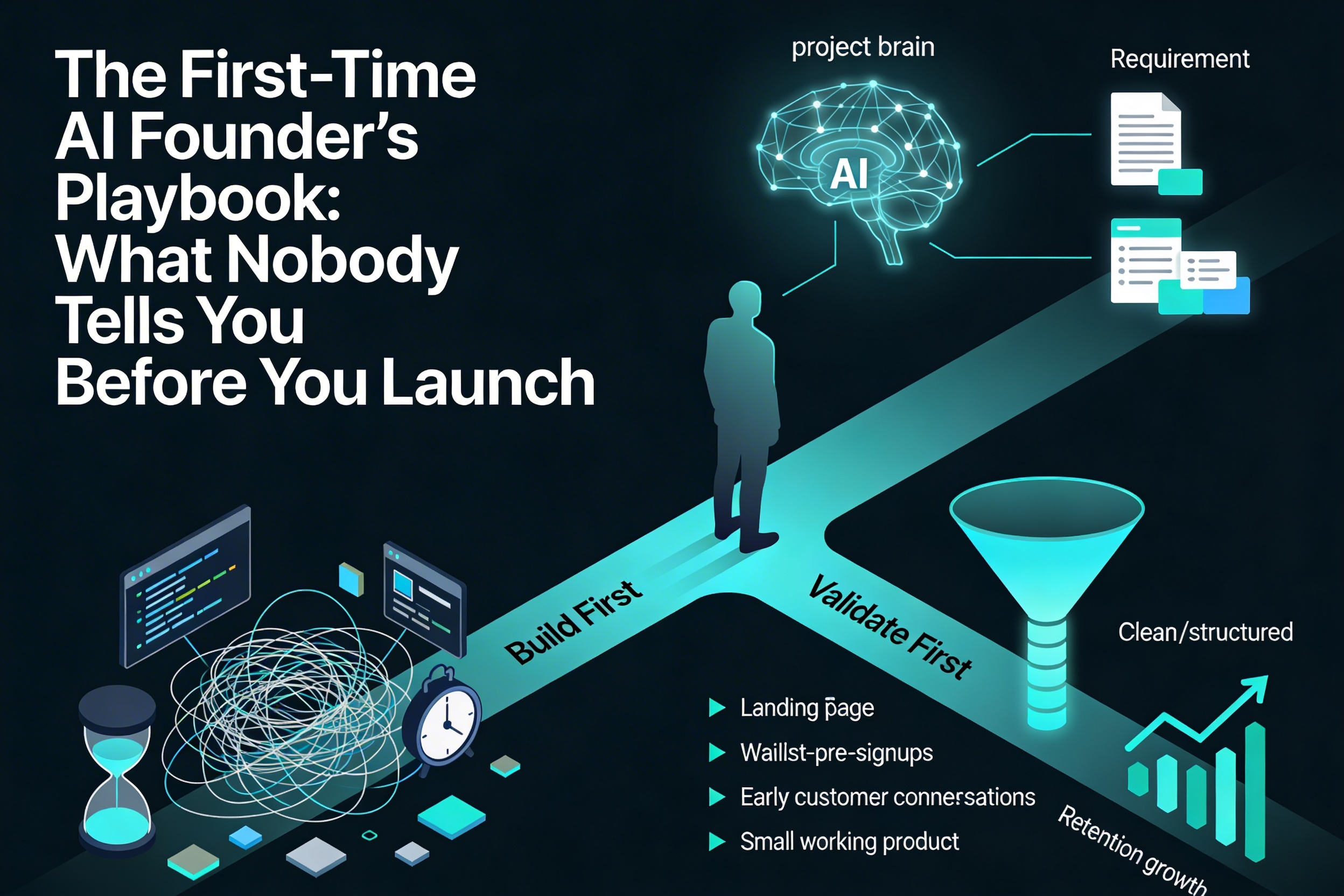
Yianni is blunt about this. The instinct to build first feels logical — after all, how can you sell something that doesn’t exist? But the answer is that you can, and you should. A landing page, a waitlist, a pre-sell email list, even just a phone number and a clear description of what you’re offering — these are enough to find out whether anyone actually cares. The goal at this stage is not to have a finished product. The goal is a signal.
“The way to do it is come up with an idea, build a landing page, market the thing first. Pre-sell. Only once you’ve actually validated the demand should you go about building anything.”
Yianni draws on a recent example of a founder preparing to invest heavily in a hardware product — sourcing molds, manufacturing in China, logistics, all of it — before a single customer had been identified. The correct sequence, as Yianni told him, was to build the landing page first, warm up an email list, and only commit to production once real demand had been confirmed. The principle is simple: sell first, then build. It runs against instinct and it works every time.
The Year-and-a-Half Problem
The cost of skipping validation is not just money. It is time — and in early-stage companies, time may be the more precious resource. Yianni spent a year and a half building his first company before he ever launched it. When the launch did not go as planned, that entire period was effectively lost. Eighteen months of work, compressed into a lesson that could have been learned in two weeks with a landing page and a few outreach messages.
The antidote is not to rush carelessly, but to launch something minimal and real as fast as possible. The product does not need to be polished. The marketing needs to be clear enough for someone to understand what problem is being solved, and the thing being sold needs to work well enough to deliver on that promise. Beyond that, speed matters more than quality at this stage.
Where Founders Waste Their Time
Busy vs. Productive
Time misallocation is one of the quietest killers of early-stage companies. It does not announce itself. It looks exactly like hard work. Founders are perpetually busy — fixing the logo, updating the website, attending networking events, optimizing their LinkedIn presence — and yet none of it moves the number that actually matters.
Yianni’s framework for founder time is brutally simple: there are only two things worth doing at any given moment. The first is addressing whatever the current bottleneck is. If something in the company is broken, the founder needs to be the one fixing it — not delegating it to someone else while continuing to work on things that are already fine. He cites a conversation with a founder generating $500,000 in revenue over two months who had a significant operational problem he was leaving entirely to someone else to resolve. The problem is not that the team member was handling it. The problem is that the founder did not understand how serious it was.
“You need to be focused on what is the bottleneck. It doesn’t do you any good to work on things that already work fine. Delegate the things that work well.”
The second priority is sales. Not the idea of sales, not the infrastructure around sales, but the actual activity of getting customers to pay for the thing you built. Without sales, nothing else matters. There is no payroll, no product development, no team, no mission. Sales is the proof that value exists — that another person is willing to trade their money for whatever is being offered.
The Logo Problem
No conversation about founder time misallocation would be complete without addressing the logo. It has become something of a proxy for the entire category of things that feel important but demonstrably are not. Yianni’s current company generates around $30,000 per month. He drew the logo by hand on one of the first days. Nobody has ever mentioned it.
This is not an argument against design. It is an argument for sequencing. A great logo on a product with no customers is a decoration on an empty room. A rough logo on a product that genuinely solves a real problem will be remembered fondly once the company grows. Do the logo last. Do it much later than you think.
The Truth About Product-Market Fit
Why the Term Is Misleading
Product-market fit has become one of the most overused and misunderstood concepts in startup culture. Founders treat it as a destination — something you either have or you are searching for — when in reality it is a moving, context-dependent signal that resists simple definition.
Yianni’s first problem with the concept is that it implies a single market. A strong AI product does not fit into one place. It can serve enterprise or consumer. It can work in transcription software or hardware. The idea that there is one correct fit obscures the reality that positioning decisions determine which version of fit you are even measuring.
His second, more important point is about what fit actually looks like when you have it. Most founders assume that getting customers means they have product-market fit. Yianni disagrees. Getting customers means people were interested enough to try your product. Product-market fit means they came back.
“The best test of product-market fit is retention. Not did people buy your product, but do they continue to use it over time. Until you have good retention, if you try to scale, you’re just going to bleed money.”
Retention Is the Metric
The retention signal is unambiguous. When the graph of active users over time goes flat — when people who tried the product are still using it months later — that is product-market fit. Everything before that point is promising evidence, not confirmation.
The practical consequence of this is significant. If you try to scale a product before you have retention, you are spending money to acquire customers who will eventually leave. The unit economics never close. You spend more and more to replace the customers you are losing, and profitability becomes structurally impossible. The only sustainable time to begin scaling is after retention is established. Before that, the job is iteration, not growth.
Why Impressive Products Fail
Cool Once vs. Cool Consistently
Technical excellence is necessary but not sufficient. This is one of the most consistent patterns Yianni observes across the startups and companies he works with: teams that build genuinely impressive AI products that still fail to gain traction because the product is interesting once but not valuable consistently.
Yianni references a framework attributed to Mark Zuckerberg that captures the distinction well. The first test is whether something is cool — whether a person actually wants to engage with it. Most technically impressive products pass this test. The second test is whether people come back. This is where most technically impressive products fail.
A product that is compelling once forces its founders into a permanent sales treadmill. Every month, new customers must be acquired to replace the ones who tried the product and moved on. There is no compounding. There is no flywheel. There is only the constant cost of acquisition with no offsetting retention. It is not impossible to build a business this way, but it is punishing.
The Marketing Translation Problem
There is a second failure mode that often accompanies technically impressive products, and it has nothing to do with the product itself. Technically capable teams tend to describe their work in technical terms. They speak to each other fluently and assume the market will follow. It does not.
Yianni worked recently with a founder who had built an entirely new agentic operating system — a genuinely remarkable technical achievement. The website was incomprehensible. Not because the founder lacked intelligence, but because the founder had never translated the technical achievement into plain language that answered the only question a potential customer actually has: what does this do for me?
“If you can’t tell me in a sentence or two what problem you solve and who you solve it for, you don’t understand the business well enough. And if you don’t understand it, I guarantee nobody else will either.”
The test is ruthlessly simple. If a stranger cannot understand what your product does and why they should care within sixty seconds of landing on your website, your marketing has failed — regardless of how good the underlying technology is. Customers do not care how hard it was to build. They care whether it saves them time, makes them money, or solves a problem they actually have.
Getting Your First 50 Customers
The Overlap Principle
Acquiring early customers is a problem of overlap. Before anything else, a founder must be clear on two things: what problem the product actually solves, and exactly who has that problem. Without both answers, every marketing and sales effort is a shot in the dark.
Once those two questions are answered, the next step is straightforward: go where those people are. For B2B AI products, that typically means LinkedIn and email. For consumer products, it may mean Instagram or TikTok. The platform choice is not aesthetic — it is strategic. Founders who build enterprise AI products and then prioritize Instagram are optimizing for an audience that does not need what they are selling. The mismatch is obvious from the outside. It is rarely obvious to the person making the mistake.
Three Levers for Early Customer Acquisition
Once presence is established on the right platforms, there are three practical mechanisms for generating early customers:
- Content. Posting consistently about the problem you solve and the way you solve it builds credibility over time. The challenge is that quality matters enormously — mediocre content rarely converts. And in the early days, most content is mediocre. Content is a long game, and most early-stage companies do not have time for long games.
- Paid advertising. A small test budget — even $500 to $1,000 — can produce useful signal. Does the ad copy resonate? Do people click through? Do any of them book a demo or sign up for a waitlist? Ads are primarily useful at this stage not as a customer acquisition channel but as a feedback mechanism. They tell you whether your message is landing.
- Direct outreach. This is the most effective early-stage customer acquisition strategy and the least comfortable one. Message people who fit your target profile. Be direct about what you built and why you think it might be relevant to them. Ask for a demo or a conversation. Do this at volume. The rejection rate will be high. The feedback will be invaluable.
Yianni’s strong preference at early stage is for outreach over content or advertising, and the reason comes down to feedback quality. Content generates impressions. Ads generate clicks. Outreach generates words — actual responses from actual people telling you what they think. Those words feed directly back into product development. They tell you what is resonating and what is not. Getting to your first 50 or 100 customers is hard by design. The founders who get there are the ones who treat it as a volume problem and keep going.
The One Mistake That Kills AI Startups
Spending Money You Haven’t Earned
If there is one mistake that consistently and predictably ends promising AI startups, it is this: spending more money than the business generates. The principle is not complicated. A business exists as long as money coming in exceeds money going out. The moment that relationship inverts and stays inverted, the clock starts. And the founder is almost always the one who started it.
The pattern is recognizable. A company begins generating revenue — real money, possibly for the first time — and instead of protecting that cash and reinvesting it into what is working, the founder starts spending. A better website. A sponsored event. Team dinners. A hire that is not yet justified by the revenue base. Each individual decision feels reasonable. Together, they quietly consume the runway that the business needs to reach profitability.
“Your ability to exist as a business comes down to the difference between the money you take in and the money that goes out. Spending too much money is basically the way that every single business dies, no matter what.”
Productive Capital vs. Busy Capital
Yianni draws a distinction that applies to money as much as it applies to time: the difference between being busy and being productive. Money, like attention, can be deployed in ways that generate returns or in ways that generate activity. Sponsoring an event is busy capital. A targeted outreach campaign that converts is productive capital. The difference is not always obvious in the moment, which is why founders need a habit of asking, before any expenditure, whether this specific use of money directly leads to more customers, better retention, or a lower cost structure.
The exception to this principle is venture-backed growth, where external capital temporarily decouples growth rate from profitability. But even here, the runway is finite. Investors eventually require a path to profitability, and companies that never develop the discipline of capital efficiency tend to struggle when growth-at-all-costs is no longer an option. For the overwhelming majority of AI founders — those without institutional backing — profitability is not optional. It is the only viable destination.
The summary is uncomfortable but necessary: most early-stage AI startups do not fail because the technology was wrong or the market was too small. They fail because the founders spent money they had not earned on things that did not matter, and ran out of time before they could course-correct.
A Framework for First-Time AI Founders
Drawing on the full conversation with Yianni Kellis, the following principles represent a practical starting framework for anyone preparing to launch an AI product for the first time:
- Validate before you build. A landing page, a waitlist, and a pre-sell email list are sufficient to test demand. Only invest in development once real signals of interest exist.
- Launch fast and small. A minimal product that ships in weeks beats a polished product that ships in eighteen months. Speed is a competitive advantage, not a corner-cutting compromise.
- Focus time on bottlenecks and sales. Everything else is noise. If something in the business is broken, fix it. If nothing is broken, sell.
- Define product-market fit by retention, not acquisition. Getting customers is encouraging. Keeping them is the proof.
- Translate technical value into plain language. If a stranger cannot understand your product in sixty seconds, rewrite the marketing. The product is not the problem.
- Go where your customers actually are. Platform choice is a strategic decision, not a personal preference.
- Do outreach first. It is uncomfortable, high-volume, and the single most effective early customer acquisition strategy available to a bootstrapped founder.
- Control expenditure like your business depends on it. Because it does.
About Thinkk.com
Thinkk is a New York-based idea lab dedicated to bringing humanity’s most innovative businesses to life. In the last twelve months, the Thinkk team has partnered with more than 65 founders to fuel the growth of their AI startups, and has built or advised over 85 startups and small businesses in total. Thinkk specializes in the earliest and most critical phase of company building—where the right decisions compound and the wrong ones quietly accumulate into failure.
Founder Yianni Kellis has spent a decade launching six companies and turning each one into a lesson he now passes forward. He also leads FameBoost, which helps Fortune 500 executives build public profiles that match their private influence. Thinkk operates on a simple conviction: if the lessons, stories, and hard-won perspectives of people who have actually built things can help the next generation of founders reach their goals faster—and avoid the mistakes that quietly kill most startups—that is impact worth pursuing.
Learn more at thinkk.com.
About StartupSword.com
StartupSword.com is an editorial platform dedicated to publishing candid, experience-first conversations with the founders, operators, and builders shaping the next generation of business. This white paper is part of the Entrepreneurship & Innovation Series, which profiles practitioners with a track record of doing the work — not just talking about it.